Blue, crafted through indigo DNA and fermentation.
Better Bluefor Everyday Denim
The blue that touches your skin throughout life has been reborn through synthetic biology. For skin health, Blugene is an indigo that never compromises—even on the smallest risks.
CutisBio proves our promises with data and official certifications.
01
We make transparent the process of producing it by fermentation from a plant-derived carbon source
We start from renewable carbon. Biobased carbon content is published as a test result.
02
For the sake of skin health, we do not compromise on even trace harmful substances
Denim sits against the skin all day. We analyze aniline and N-methylaniline, impurities that can remain in synthetic indigo, by accredited test methods and publish the results together with the detection limit.
03
We prove environmental friendliness and sustainability with official certifications
Test report numbers, certificate numbers and original certificate images can be checked directly on this site.
Because it touches our skin for a lifetime, a dermatologist checks its safety.
No matter the country or age, denim is part of our daily life. Because it is worn for years and touches the skin every day, we re-examined every step, from making the color and dyeing to the moment the denim is worn, together with dermatologists, the specialists in skin health. Blugene began with the following three questions.
Skin safety of fabrics dyed with Blugene indigo, confirmed together through third-party testing.
We can partner with denim and jeans brands to arrange third-party testing of artificial-sweat extracts from fabrics dyed with Blugene indigo, including single-application and cumulative skin irritation studies. We can provide participating brands with laboratory reports and fabric-specific test summaries to support clear, evidence-based product communication.
Results apply to the tested fabric extracts and study conditions.
WHAT REMAINS MATTERS
Our standards reach beyond what you can see.
In the tests presented in the catalog, CutisBio bio indigo, the foundation of Blugene, showed that aniline and N-methylaniline were not detected.
Aniline and N-methylaniline are used as starting materials or intermediates in chemical synthesis routes, and they can remain as unreacted residues in the final indigo powder. A number of certification standards limit the permitted concentration of these substances in textile dyes and in finished products.
Aniline (mg/kg)
Not detectedN.D.
N-methylaniline (mg/kg)
Not detectedN.D.
Method detection limit
5 mg/kg
Test method
KS K 0734 2019
Testing institute
KOTERI (Korea High Tech Textile Research Institute)
Test report number
2025-0604-1132-C03(Test report date 2025-06-10)
Not detected (N.D.) means below the method detection limit under the stated test method. It is not a measured value of 0, and it is not shown as a zero bar in the charts.
EU CLP · IARC
How regulators classify them
How regulators classify the two substances. This is why the test results below measure them.
Aniline
C₆H₅NH₂ · CAS 62-53-3
Toxic in contact with skin (H311)
May cause an allergic skin reaction (H317)
Causes serious eye damage (H318)
Suspected of causing genetic defects (H341)
Suspected of causing cancer (H351)
Causes damage to organs through prolonged or repeated exposure (H372)
IARC Group 2A — probably carcinogenic to humans
N-methylaniline
C₆H₅NHCH₃ · CAS 100-61-8
Toxic in contact with skin (H311)
Toxic if swallowed or inhaled (H301 · H331)
May cause damage to organs through prolonged or repeated exposure (H373)
Hazard statements from the harmonised classification in Annex VI of the EU CLP Regulation (EC) No 1272/2008. The IARC evaluation is from the 2020 meeting (Volume 127).
Aniline and N-methylaniline analysis of commercial indigo dyes
Aniline (mg/kg)
N-methylaniline (mg/kg)
N.D.Not detected
Every value in the charts can also be found in the tables below.
Aniline and N-methylaniline analysis of commercial indigo dyes
Sample
Indigo type
Aniline (mg/kg)
N-methylaniline (mg/kg)
Company S
Chemical
1,524
828
Company M
Chemical
369
225
Company Z
Chemical
1,229
1,127
Company M
Plant
Not detected
Not detected
Company XT
Plant
131
85
Company I
Plant
Not detected
Not detected
Company XB
Plant
Not detected
Not detected
Company H
Plant
2,652
2,375
CutisBio
Bio
Not detected
Not detected
Not detected (N.D.) means below the method detection limit under the stated test method. It is not a measured value of 0, and it is not shown as a zero bar in the charts.
CutisBio produces indigo by utilizing microorganisms' biosynthetic pathways and fermentation.
From feedstock to fabric
Concept image
01
Renewable feedstock
Renewable carbon from biomass such as corn is the starting point.
02
Microbial fermentation
Indigo is made by fermentation that draws on the biosynthetic pathways of microorganisms.
03
Indigo recovery and product forms
After recovery and purification, it is made into powder and digital printing ink.
04
Fabric dyeing and printing
It is applied to cotton, silk and cashmere dyeing and to digital printing.
Blugene's journey into denim begins with renewable plant feedstock: the blue DNA of indigo is reborn as dye and ink through synthetic biology and precision fermentation. The resulting Blugene indigo dye holds certifications such as ZDHC MRSL, OEKO-TEX ECO PASSPORT and USDA BioPreferred, and it is the dye that colors the denim we wear.
Thinking of skin safety. Thinking of the environment and sustainability, too.
An indigo that starts from renewable carbon. From the origin of the feedstock through to compositional analysis, we explain our approach with material you can verify.
98%
Biobased carbon content of Blugene
The origin of the carbon was confirmed by testing.
This is a ratio based on the organic carbon of the test sample. It does not mean the plant-derived content of a pair of jeans, the purity of the indigo, or a reduction in carbon emissions.
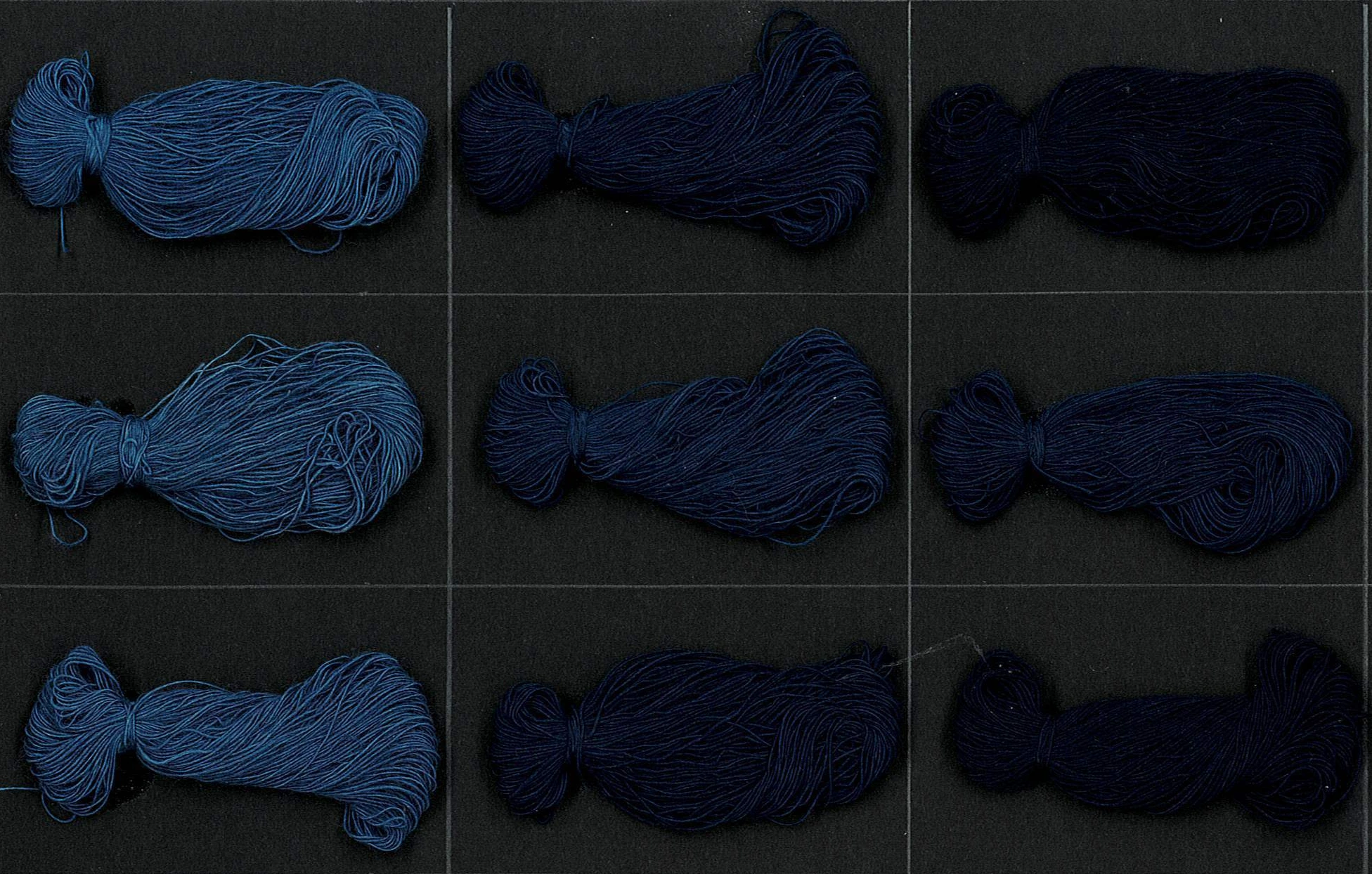
Test photos of the same skeins dipped 1, 3 and 5 times in petrochemical indigo and in Blugene, placed side by side. We show the photos as they are, without converting them into numbers.
Color development by number of dyeing cycles
Test photograph
Blugene dyeing demonstration case 1
1 dip
3 dips
5 dips
Petrochemical indigo
Blugene 1
Blugene 2
Dyeing comparison photo provided by CutisBio. Skeins dyed with petrochemical indigo, Blugene 1 and Blugene 2, photographed side by side after 1, 3 and 5 dips.
Test photos provided by CutisBio, shown without colour correction. The colour depth in the photos was not converted into K/S values or ΔE colour-difference measurements, and the photos do not mean superiority under all conditions.
Test results and certificates are gathered in one place. Each item is shown with its testing institute, test method, report number and data as-of date, and the original can be viewed.
Indigo made by microbial fermentation is supplied as a powder for fabric dyeing and as an ink for digital printing.
Blugene Indigo Powder
Catalogue p.8
Cotton, silk, and cashmere dyeing evaluation data are included in the catalog.
CAS
482-89-3
The product names above are the web-facing names of the new brand. In the catalogue and the certificates the original product name is “Bio Indigo Dye Powder (Microbial Fermentation) / CB Bio Indigo Dye Powder”.
Blugene Digital Printing Ink
Catalogue p.9
A bio indigo ink for digital printing. We are glad to discuss applications and samples with you.
The product names above are the web-facing names of the new brand. In the catalogue and the certificates the original product name is “BioIndigo Digital Printing Ink”.
Particle size, viscosity, shelf life, minimum order quantity, production capacity and pricing are not in the supplied material and are therefore not shown. Please contact us and we will confirm the specifications you need.
Let's create your next blue.
We welcome inquiries from denim brands, fabric mills, dye houses, and printing companies.